
You
have subscribed to Joe Ross' Weekly Spread Scan Newsletter.
If you have problems reading this newsletter, please follow this link:
Spread
Scan Issue: October 23, 2006 - Volume 115
To unsubscribe, scroll past the end of this newsletter and click the "unsubscribe" link.Otherwise, welcome to this week’s issue of the
Joe Ross Spread Trading Newsletter.Each week we present spread trading examples and opportunities in order to help you become a more professional spread trader.
Be sure you receive all your issues of Spread Scan so that you can continue to enjoy learning through the best free educational trading information available, and so that we can keep you informed about additional educational services and products to help you grow as a successful and profitable spread trader.
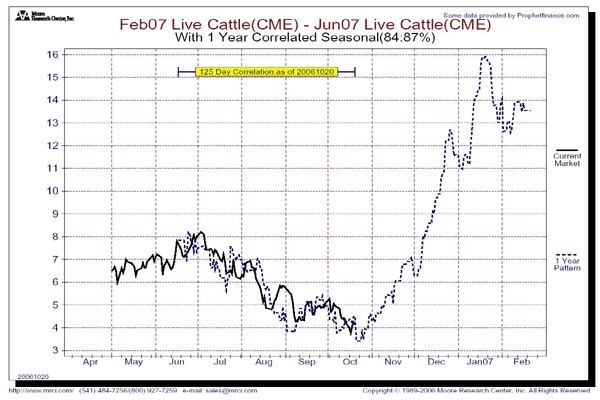
Spread charts provided by Moore Research Center, Inc. (800) 927-7259, www.mrci.com
Today we consider an intra-market meats spread: long February 07 Live Cattle and short June 07 Live Cattle (LCG7 – LCM7). On the chart above, we see what is called a “correlation chart” (1 year correlation over the last 125 days to the year 1984). Will the spread stick to its correlation and move up? We never know, but we can build a trading plan around our trading idea, and the chart above can help us to find a possible stop, time stop, and target.
Traders may want to enter the spread a value of 4.25. Margin for the spread is $405 (reduced margin). Suggested risk is $300. Initial projected objective is $300, then a move to 8 or higher. Very low volume in LCM7. Please check with your broker for the best entry.
On October 11 we told subscribers of our daily newsletter, Traders Notebook, "Consider entering an intra-market soy complex spread SF7 – SN7 MOC on Tuesday. Margin for the spread is $135 (reduced margin). Suggested risk is $200. Initial projected objective is $200, then a move to –10 or higher. Basis is seasonal (app. 10/01 – 11/30) and a breakout of the September high. Comment: I have been following this spread for awhile but could not see any entry signal. Now, after the break out of its September high, it looks like the spread could move higher."
Also recommended in Spread Scan Vol. 113.
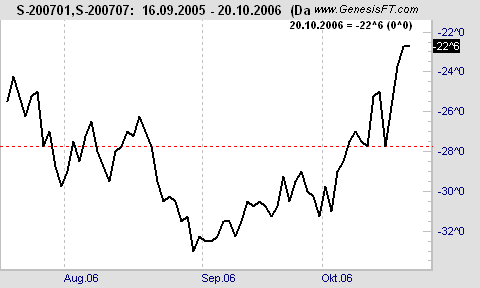
Here's how we suggested managing this trade:
10/11 In?
10/16 Suggest moving the stop to –27 ¾.
10/18 Suggest taking some money from the table and moving stop to break even.
10/19 Spread hit first suggested target. Suggest moving stop to break even.Open equity on remaining contracts: $250 per contract. Please keep in mind that we already realized profits of about $200.
For more information about our daily newsletter, read on below or visit
http://www.spread-trading.com/tradersnotebook/index.htm

Questions or Comments? Please email us: support@spread-trading.com
Student's Question: "Andy, I heard that when you start out you have more losses than wins. Is it true?"
Andy: A cold, hard fact of trading is that you'll see more losses than wins, especially when you are first starting out. Yes, it is true. Trading is a business in which losses can be numerous, especially at the beginning. Feeling that you have to trade perfectly and make a profit on almost every single trade is unrealistic. It is important that you not allow yourself to become stressed to the point where you have difficulty focusing on the trades that actually will produce a big profit.
The best advice I know of is to be flexible and ready to adapt to market conditions. Markets change, and you must change with them. Joe Ross told me the concept of the Law of Charts has never changed. But the management to properly use that law does change because speed at which formations change varies with the volatility of the market. Management changes, as well, with the magnitude of move as it changes. You have to be wise in trading, and acknowledge that many times things will not go your way.
Every time you make a trade, you put money on the line. To the professional trader, money is nothing more than intangible "capital." It loses some of its significance. There is a danger to that as well. Once money loses its significance, it is easy to become careless. But to a novice trader, money represents need for essentials, like food and clothing and rent. When you think of your margin account as real money, there's a strong need to want avoid any losses at all. You are afraid to make a mistake and lose your hard-earned money. This is why no one should ever trade with money that, worst case, he cannot afford to lose - because that situation will automatically force that person to be a gambler, not a trader.

"You have my word that you've probably heard about, but have almost surely ignored, the area of trading I'm about to reveal to you. It is unlike anything you may have seen before!
Thousands of traders purchased the first edition of my book Trading Spreads and Seasonals, and in July we started to release an updated version (May 2006) of this wonderful manual about Spread Trading."
Follow this link to find out more about Trading Spreads and Seasonals...
© 2006 by Trading Educators, Inc
Contact
Us
1509 Jackson Drive
Cedar Park, TX 78613
Phone: 800-476-7796 or 512-249-6930
You
can e-mail us: support@spread-trading.com
Office hours are Monday - Friday 9 A.M. to 5 P.M., U.S.C.T.
Unsubscribe or change subscription
To change your subscription or to unsubscribe, scroll past the end of this
newsletter to click the "unsubsribe" link.
Disclaimer:
The Commodity Futures Trading Commission has asked us to advise you that trading spreads is complex and carries a high degree of risk. While there is opportunity for incredible wealth building, there is also the risk of losing even more than you invested. Of course, that's not unlike most other businesses. But informed traders are the best traders!