|
You
have subscribed to Joe Ross' Weekly Spread Scan Newsletter.
If you have problems reading this newsletter, please follow this link:
Spread
Scan Issue: November 27, 2006 - Volume 120
To
unsubscribe, scroll past the end of this newsletter and click the
"unsubscribe" link.
Otherwise,
welcome to this week’s issue of the
Joe Ross Spread Trading Newsletter.
Each
week we present spread trading examples and opportunities in order
to help you become a more professional spread trader.
-
-
-
- Trading Order Power Strategies
- Contact
Us
Be sure
you receive all your issues of Spread Scan so that you can continue to
enjoy learning through the best free educational trading information
available, and so that we can keep you informed about additional educational
services and products to help you grow as a successful and profitable
spread trader.
|
Spread Scan Example:
This
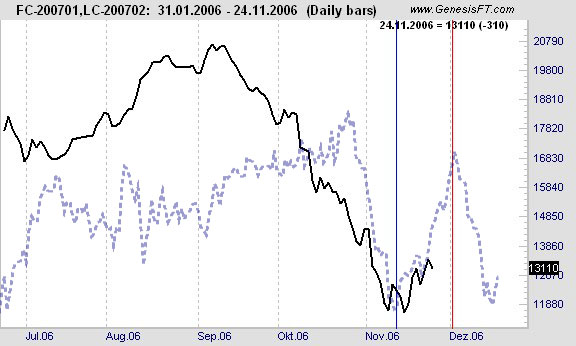
week we look at 500*FCF7 – 400*LCG7.
Today
we consider an inter-market meats spread: long January 07 Feeder
Cattle and short February 07 Live Cattle (500*FCF7 – 400*LCG7).
After being in a down trend in September and October, the spread
turned around and has been moving up for about one week. Seasonality
should move the spread higher (light blue line) until the end of November.
But after the seasonal up-move in November, we see a strong
seasonal down-move in December.
Traders
may want to enter the spread at $13,100. Margin for the spread is
$2,971 (no reduced margin) or $2,195 if you get fractionalized spread
credit (ask your broker). Suggested risk is $1,200. Initial projected
objective is $1,200, then a move to $18k or higher. Please note:
The spread is 1:1. The multipliers 500 and 400 are used to give
us the right spread value in US$.
|
On
October 23 we told subscribers of our daily newsletter,
Traders
Notebook, "Consider entering an intra-market wheat spread
WZ7 – WH7 MOC on Monday. Margin for the spread is $1,350 (reduced
margin). Suggested risk is $1,000. Initial projected objective is
$1,000, then a move to break even or higher. Basis is seasonal (app.
10/25 – 02/30) and a RH. Comment: Wheat is moving up like crazy. I
personally would try to get into the trade at least with 2 lots. I
would get rid of the first lot pretty quickly and would leave the second
for a long term trade."
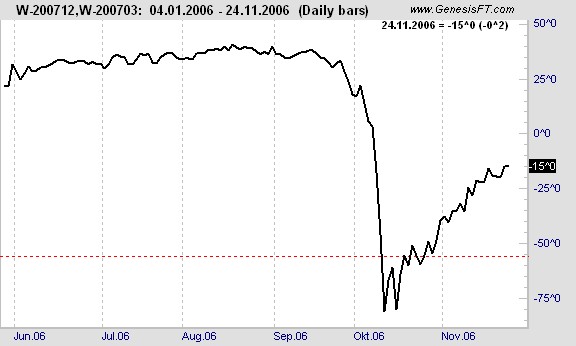
Here's
how we suggested managing this trade:
10/23
In?
10/30 Spread is having a hard time. It just doesn’t
want to move up. I personally would exit if the spread doesn’t move
up to my first target by Friday.
10/31 Spread is close to the first suggested target.
Suggest moving the stop to –54^4.
11/01 Suggest taking some money from the table if
not already done.
11/03 Spread hit first suggested target.
11/07 Suggest moving the stop higher to –49.
11/09 Suggest moving the stop higher to –40 ½
11/13 Suggest moving the stop higher to –35 ½.
11/21 Suggest moving the stop to –28.
11/22 Suggest moving the stop to –22.
11/24 Suggest moving the stop to –19 ¾ (if you think
the stop is too close, leave it farther away).
Open
equity on remaining contracts: $2,000 per contract.
Please keep in mind that we already realized profits of about $1,000.
For more
information about our daily newsletter, read on below or visit
http://www.spread-trading.com/tradersnotebook/index.htm

Questions
or Comments? Please email us: support@spread-trading.com
back
to top |
Andy Jordan's
Trading Bites
Student's
Question: "Andy, can you give me some idea of how
much money I should risk on each trade?"
Andy:
This is really a tough one because I do not know enough about you, your trading style, or the money you trade. But I will
try to give you some general ideas. I personally feel the most logical way
is to use a certain % of my trading account on each trade. For example, if your trading account is $20k, and you are willing to risk 5%
on each trade, you would trade $1,000 on your first trade. If your
account grows to $22k, you would then risk $1,100 on the next trade,
and so on.
Now you will probably come up with the following question:
“What % should I use for my trading?” And this is the point where
the problem starts. If you use too much on each trade, you
will be out of the game whenever you have several consecutive losses.
If you are risking too little, your account will grow really
slowly. Without going into details, try to think about the following
points:
- how many consecutive
losing trades are possible the way I am trading?
- what is the maximum drawdown I am able to accept?
I totally agree
when you say it is very difficult to find out how many consecutive
losing trades your trading style can produce. We are not able to
look into the future, and anything is possible in trading. But your
trading journal will give you a good estimation. If this trading
style or method is new for you, you should try to get a good estimation
from somewhere else or you should do some paper trading to get at
least an idea. With these numbers (how many consecutive losers and
maximum drawdown) you are now able to find out if the percentage
of risk on each trade is too little or too much for the way you trade.
All you have to do is to calculate the balance of your trading account
after all the consecutive losses, using the percentage of risk you
are willing to take on each trade. If this is something you can
live with, stick with it. If not, lower or raise the risk on each
trade, and do the calculation again.
|
Trading Order Power Strategies -
Special Price

Get it for only $75
Here
is what Trading Order Power Strategies is all about:
"Trading
Order Power Strategies" (a tape and book course) is an interactive
course that shows you, in step-by-step detail, how to make
sure your called-in orders are almost always executed in your favor.
This breakthrough program, the first of its kind anywhere,
has been hailed by brokers, educators, and traders alike as
"the missing link" in a trader's education. When
you learn what's included in the program, you'll know why.
"Trading Order Power Strategies" includes a special insert for
fully electronic trading, as well as electronic order routing.
The
"Trading Order Power Strategies" program uses a dynamic learning
technology, combining audio tapes and written materials in
a way that greatly shortens your learning curve. The program
includes four one-hour audio tapes, a 12-chapter Study Guide,
and the Electronic Trading booklet mentioned above - all professionally
produced to help you learn as much as possible in the least
amount of time.
Follow this link to order "Trading Order Power Strategies" -
Yours for the taking...
|
Join our Trading Community Forum at Trading Educators!

Link
Me to the Forum Now!
|
|
| ©
2006 by Trading Educators, Inc
Contact
Us
1509 Jackson Drive
Cedar Park, TX 78613
Phone: 800-476-7796 or 512-249-6930
You
can e-mail us: support@spread-trading.com
Office hours are Monday - Friday 9 A.M. to 5 P.M., U.S.C.T.
back
to top
|
Unsubscribe
or change subscription
To
change your subscription or to unsubscribe, scroll past the end of this
newsletter to click the "unsubsribe" link.
|
Disclaimer:
The Commodity
Futures Trading Commission has asked us to advise you that trading spreads
is complex and carries a high degree of risk. While there is opportunity
for incredible wealth building, there is also the risk of losing even
more than you invested. Of course, that's not unlike most other businesses.
But informed traders are the best traders!
|