
You
have subscribed to Joe Ross' Weekly Spread Scan Newsletter.
If you have problems reading this newsletter, please follow this link:
Spread
Scan Issue: February 14, 2007 - Volume 131
This email was sent to you by Trading Educators.
To ensure delivery to your inbox (rather than to bulk or junk folders)
please add info@spread-trading.com to your address book.To unsubscribe, scroll past the end of this newsletter and click the "unsubscribe" link.
Otherwise, welcome to this week’s issue of the
Joe Ross Spread Trading Newsletter.Each week we present spread trading examples and opportunities in order to help you become a more professional spread trader.
Be sure you receive all your issues of Spread Scan so that you can continue to enjoy learning through the best free educational trading information available, and so that we can keep you informed about additional educational services and products to help you grow as a successful and profitable spread trader.
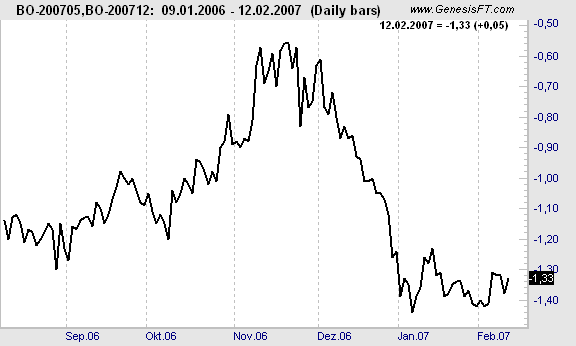
Today we consider an intra-market bean oil spread: long May 07 Soybean oil and short December 07 Soybean oil (BOK7 – BOZ7). The spread has been going sideways since a strong down move in December 2006. The down trend seems to be broken. Normally the spread has a seasonal up-move in February (approx. 2/1 – 2/10) and gives us a possible 1-2-3 low for an entry.
Traders may want to enter the spread at a value of –1.30. Margin for the spread is $135 (reduced margin). Suggested risk is $120. Initial projected objective is $120, then a move to –0.60 or higher. Basis is seasonal and a 1-2-3 low.
On January 31 we told subscribers of our professional daily spreads & position trading newsletter, Traders Notebook, "Consider entering an inter-market spread SK7 – 2*CK7 at a spread value of –94 ¼. Margin for the spread is $3,780 (no reduced margin). Suggested risk is $1,600. Initial projected objective is $1,600, then a move to 50 or higher. Basis is seasonal (app. 2/5 – 3/15) and a 1-2-3 low. More conservative trader might wait for the next Ross Hook. Comment: Only in 1996 did the spread move below –100 (data goes back to 1971). Along with a strong seasonal up move in February and March, the spread seems to be attractive. Important report (Crop Production & WASDE Report) on 02/09."
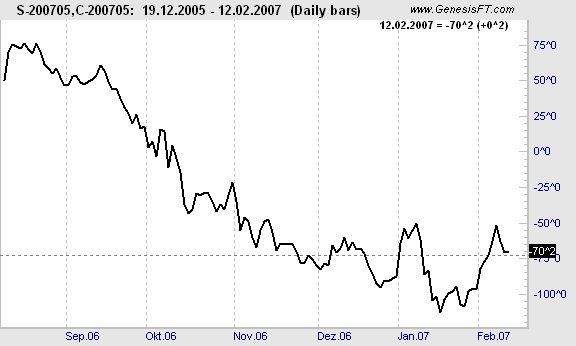
Here's how we suggested managing this trade:
02/01 Suggest entering MOC tomorrow.
02/02 In?
02/06 Suggest taking some profits tomorrow and moving the stop to break even.Open equity on remaining contracts: $300 per contract. Please keep in mind that we already realized profits of about $1,000.
For more information about our daily newsletter, visit our website:
http://tradingeducators.com/studentsonly.htm or visit our Spread Website to find out more about Traders Notebook
Questions or Comments? Please email us: support@spread-trading.com

Student's Question: "Andy, can you tell us a bit more about carrying charges and how to calculate them?"
Andy: Carrying charges are the cost of storing, insuring, and financing a commodity over time. In futures, they limit the premium of deferred delivery over a more nearby contract. If it were otherwise one could, for example, simultaneously buy March and sell July futures, take delivery of cheaper wheat in March, store it, and then redeliver more expensive wheat in July - all for a risk-free profit.
Here is what the CBOT tells us about Carrying Charges:
“Information concerning carrying charges, deliveries, receipts & storage costs for CBOT listed products can be found in each product’s corresponding chapter in the About CBOT section.”
So far so good, but how to calculate carrying charges?
Maximum storage rates are set by the exchange. The CBOT sets the maximum for wheat at 0.015 cents/bushel/day, or 4.5 cents/bushel for a 30-day month. Insurance is nearly negligible, and is usually included as a part of storage. Financing costs are normally calculated with the price of the nearby contract at the prime rate plus 1.00%. For example: March Wheat is at about $4.63/bushel, and the prime rate at 8.25% per year (remember to divide the yearly cost for the amount of actual time elapsed), the cost to finance is about 3.57 cents/bushel/month. Thus, total carrying charge for one month (storage plus finance) is about 8.07 cents/bushel/month. For example, full carry from March to July (4 month) would then be about 32.25 cents/bushel.
Most spreads never go to fully carry because the commercials borrow money at rates below the published prime rate. The practical expectation would be approximately 80% of full carry for the widest point a particular spread may go. In our example above, the practical expectation for our March – July Wheat spread would be about 25.80 cents/bushel.
Online Spread Training for YOU
Spread Trading is one of the most consistently reliable, potentially profitable, and safest ways to achieve real success in trading.
If you have previously looked into Spread Trading, but you have not been able to figure exactly how to use spread trading to be consistently profitable, then this is what we have for you:
This is YOUR chance to TRADE and INTERACT online, ONE-ON-ONE, with a professional and knowledgeable Spread Trader. During one whole trading week YOU will get all the attention you need to get a better understanding of Spread Trading itself, and how to spread trade the markets for profit. You will learn to select the right markets and the right spreads. Your Mentor, Andy Jordan, will show you distinct ways to dig out high probability spreads. You will develop a spread trading plan including money management, risk management, and trade management.
There is so much for you to receive and learn during this whole week that is tailored towards YOUR own needs.
This one week online Spread Training is a great value at $997. The training experience, the professional help including all the tools and information you will get, are the best investment you can make towards becoming a proficient, knowledgable, and profitable Spread Trading expert.

© 2007 by Trading Educators, Inc
Contact
Us
1509 Jackson Drive
Cedar Park, TX 78613
Phone: 800-476-7796 or 512-249-6930
You
can e-mail us: support@spread-trading.com
Office hours are Monday - Friday 9 A.M. to 5 P.M., U.S.C.T.
Unsubscribe or change subscription
To change your subscription or to unsubscribe, scroll past the end of this
newsletter to click the "unsubscribe" link.
Disclaimer:
The Commodity Futures Trading Commission has asked us to advise you that trading spreads is complex and carries a high degree of risk. While there is opportunity for incredible wealth building, there is also the risk of losing even more than you invested. Of course, that's not unlike most other businesses. But informed traders are the best traders!