
You
have subscribed to Joe Ross' Weekly Spread Scan Newsletter.
If you have problems reading this newsletter, please follow this link:
Spread
Scan Issue: September 05, 2007 - Volume 160
This email was sent to you by Trading Educators.
To ensure delivery to your inbox (rather than to bulk or junk folders)
please add info@spread-trading.com to your address book.To unsubscribe, scroll past the end of this newsletter and
click the "unsubscribe" link.Otherwise, welcome to this week’s issue of the
Joe Ross Spread Trading Newsletter.Each week we present spread trading examples and opportunities in order to help
you become a more professional spread trader.
Be sure you receive all your issues of Spread Scan so that you can continue to enjoy learning through the best free educational trading information available, and so that we can keep you informed about additional educational services and products to help you grow as a successful and profitable spread trader.
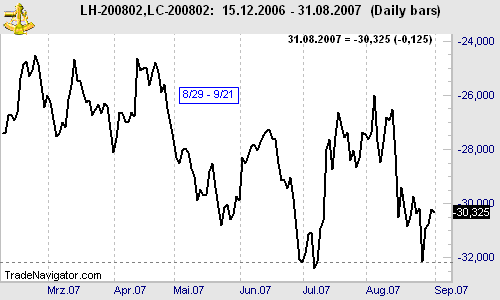
Today we consider a meats spread: long February 08 Lean Hogs and short February 08 Live Cattle (LHG8 – LCG8). The spread has tested the low at -32 three times (in June, July, and August). Seasonal statistics tell us the spread should start its move upward around 08/29. If so, the spread should not fall below the August 2007 low anymore, and therefore that could be a good place for a mental stop.
Traders may want to enter the spread at a value of -30.10. Initial margin for the spread is $790 (reduced margin). Suggested risk is $800. Initial projected objective is $800, then a move to -26 or higher. Basis is seasonal (app. 8/29 – 9/21).
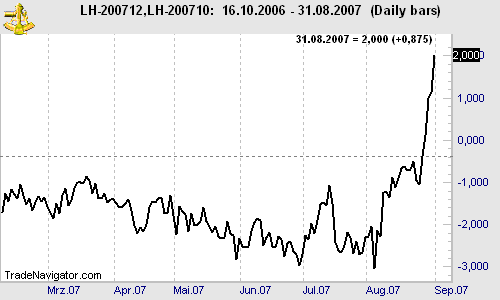
On August 26 we told subscribers of our professional daily spreads & position trading newsletter Traders Notebook, "Consider entering a calendar spread LHZ7 – LHV7 on the next up move. Initial margin for the spread is $675. Suggested risk is $400. Initial projected objective is $400, then a move higher. Basis is seasonal (app. 8/22 – 8/31) and a RH. Comment: More conservative traders can wait till the spread moves above the hook at -0.50. More aggressive traders can enter at the moment the spread starts to move up."
Here's how we suggested managing this trade:
08/27 In? If not, suggest entering MOC.
08/30 Suggest exiting MOC tomorrow (or during the day). The meats will close one hour earlier!
08/31 Out? If you are still in with some of your contracts, suggest using a trailing stop of $400.For more information about our daily newsletter, visit our Spread Website to find out more about Traders Notebook
Questions or Comments? Please email us: support@spread-trading.com

Trade Management - the key to being successful
by Joe RossAll too many traders focus their efforts on identifying buy and sell signals. In fact, that’s what most trading books consist of — some way to find buy and sell signals. Trading systems are usually all about “where to get in.”
The research and analysis traders do is geared towards reaching the goal of getting that magic “base line” directive to guide their actions. This is not wisdom.
Any successful, experienced trader will tell you that although properly identifying buy/sell signals is important, it’s not the key to being successful. Instead, the way you manage each trade is what determines your success.
Traders who take the baseline approach tend to believe that the success of their trading activity is dependent on following the right buy/sell signals at the right time. Clearly, it’s important that a trader be able to understand the process of generating signals and to use the methods involved. Realistically though, almost any trader can find a way to generate signals, whether by using technical methods already out there, coming up with their own system, or using their platform’s automated signal generation tools.
Any successful, experienced trader will tell you that your trade doesn’t begin and end with a buy or sell. There’s a trade management process involved. For each trade you make, you’re making a group of decisions. The way you manage and time those decisions is what determines the level of success of your trade.
Let’ say two traders get the same signal at the same time, and act on it. One’s trade may result in profits while the other’s results in losses. How is this possible? It can occur because each trader made a different combination of decisions throughout the course of the trade. The decisions might include scaling in and/or out of the trade, using or not using trailing stop losses, setting or not setting profit objectives prior to entry, patience or lack thereof, etc. The trader who made the most effective overall combination of decisions will have the better trade results in the end. Of course, there are time when pure chance gives the better result to the worst trader.
It’s very important to regard trading as a process, and to understand that, as a trader, your efforts need to be focused on the activity of trading itself as opposed to getting a quick base line answer. Because there are many things to take into consideration in making your trades successful, it’s essential that you educate and train yourself in all the different areas. Learn how to develop better trading plans and analysis methods, and then learn how to apply what you’ve developed to the process of making a trade – from the original impulse to enter or to stay out of a trade to the control of your thought processes and emotions in managing that trade.
Manage your trades and yourself! In his newly revised "Trading Is a Business," Joe shows you how to become a more successful trader by showing you how to properly manage your trades and yourself. Make your trading more profitable! Joe has called this manual Trading Is a Business because his purpose is to teach you what he knows about the business of making money in the markets. He specifically shows you how to increase the focus and profitability of your trading. Joe shows you how to run your trading as a business, with an economic motivation and with sound management. Follow this link now for more details about this popular book ..... |
Trading Is a Business by Joe Ross
|

©
2007 by Trading Educators, Inc
Contact
Us
1509 Jackson Drive
Cedar Park, TX 78613
Phone: 800-476-7796 or 512-249-6930
You
can e-mail us: support@spread-trading.com
Office hours are Monday - Friday 9 A.M. to 5 P.M., U.S.C.T.
Unsubscribe or change subscription
To change your subscription or to unsubscribe, scroll past the end of this
newsletter to click the "unsubscribe" link.
Disclaimer:
The Commodity Futures Trading Commission has asked us to advise you that trading spreads or outright futures is complex and carries a high degree of risk. While there is opportunity for incredible wealth building, there is also the risk of losing even more than you invested. Of course, that's not unlike most other businesses. But informed traders are the best traders!