
You
have subscribed to Joe Ross' Weekly Spread Scan Newsletter.
If you have problems reading this newsletter, please follow this link:
Spread
Scan Issue: October 3, 2007 - Volume 164
This email was sent to you by Trading Educators.
To ensure delivery to your inbox (rather than to bulk or junk folders)
please add info@spread-trading.com to your address book.To unsubscribe, scroll past the end of this newsletter and
click the "unsubscribe" link.Otherwise, welcome to this week’s issue of the
Joe Ross Spread Trading Newsletter.Each week we present spread trading examples and opportunities in order to help
you become a more professional spread trader.
Be sure you receive all your issues of Spread Scan so that you can continue to enjoy learning through the best free educational trading information available, and so that we can keep you informed about additional educational services and products to help you grow as a successful and profitable spread trader.
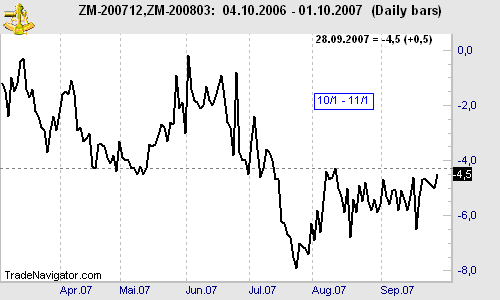
Today we consider a calendar spread: long December 07 Soybean Meal and short March 08 Soybean Meal (SMZ7 - SMH8). The spread has been trading sideways for about a month now. The seasonal time window goes from approximately October 1st until November 1st. Will a breakout of the trading range be the start of its seasonal up move?
Traders may want to enter the spread at a value of -4.0. Initial margin for the spread is $169 . Suggested risk is $200. Initial projected objective is $200, then a move up to -1.0 or higher. Basis is seasonal (app. 10/1 - 11/1) and a breakout of a trading range. Comment: I personally would wait for a nice breakout of the range (on the close) and enter the next day via MOC order.
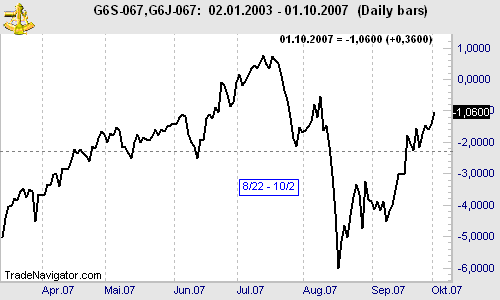
On September 25 we told subscribers of our professional daily spreads & position trading newsletter Traders Notebook, "Consider entering a currencies spread SFU7 - JYU7 at a spread value of -3.50 or better. Initial margin is $1,215 (reduced margin). Suggested stop at -5.6 (August low). Initial projected objective is -1.00, then higher. Basis is seasonal (app. 8/22 - 10/2) and a 1-2-3 low. Comment: Please calculate the risk on your own, depending on the entry."
Here's how we suggested managing this trade:
08/28 In?
08/29 Suggest taking some money from the table and moving stop to break even.
09/07 Suggest rolling into December but only if the spread moves up on Monday. Otherwise suggest exiting MOC.
09/18 Suggest moving stop to -3.00
09/21 Suggest moving stop to -2.30For more information about our daily newsletter, visit our Spread Website to find out more about Traders Notebook
Questions or Comments? Please email us: support@spread-trading.com

The moral justification for trading
by Joe RossWhen I first began trading, a fairly substantial percentage of futures contracts actually ended up in a delivery — certainly more than we see today. Today only 3% of contracts result in delivery.
The economic and social justification for the futures markets is to provide a venue in which producers and users can hedge against excessive fluctuations in price. With hedging as its justification, speculation in futures serves as a way of providing liquidity, efficiency, and price discovery. The trader serves as the person who is willing to take the risk the hedger wants to avoid. Without that justification, trading futures is nothing more than outright speculation.
However, it is difficult to see how trading a 1-, 3-, or 5-minute chart meets the criteria for providing liquidity and price discovery for the hedger. Does a producer or consumer need to hedge for only 1 minute? It is hard to argue on the basis of short-term intraday trading that anyone is actually providing any social or economic benefit of any kind.
Whereas with longer-term trading it is easy to see the social and economic benefits provided by the speculator, it is virtually impossible to see that such benefits are derived from short-term trading. That renders daytrading as nothing more than speculating. To that extent, the futures markets may have become giant gambling casinos.
That raises a question: What is the difference between the gambler and the speculator?
True speculation is based on taking advantage of the realities of the market. Gambling is an attempt at trying one's luck.
The true speculator is willing to accept the risk of price fluctuation in return for the greater leverage that comes with that risk, in the hopes of earning a greater profit. The true speculator makes his trading decisions based on knowledge gathered from information about the behavior of the underlying, seasonality, historical and current trends, chart analysis, fundamentals, the market dynamics, and knowledge of those who trade that market. But what about the gambler? How does he make his decisions?
The gambler makes his trading decisions on gut feelings, hopes, dreams of getting rich quick, tips from the broker, "inside information" from friends, and from the improper understanding and use of indicators, oscillators, moving averages, and mechanical trading systems. In general, he is looking for a way to shortcut having to truly learn what is going on. Unfortunately, most people who attempt to trade fall into this category. Many wannabe traders are gambling and they don't even realize it. Anyone who attempts to trade without essential knowledge of what the markets are all about and how they truly function, is gambling.
There is one more aspect to this subject. It has to do with morality. I am often asked if trading goes against the teachings of the Bible. Is it a sin to trade? Is it a sin to speculate in the markets? I have been asked this question numerous times even by church pastors. My friend Kent Calhoun said it this way: "You did not pay to be born. Life is a gift that was freely given to you. The ways in which you repay God for your life is by using your natural talents to the best of your ability and constantly creating positive change in your life and the lives of others. This quest fulfills the meaning of life, to make the world a better place because you were here. What are your talents and abilities? What is the most important goal in your life? How do you exercise your talent on a regular basis to achieve that goal? How are you creating positive changes in your life and the lives of others? What is the legacy you will leave behind to show mankind that you ever existed? May God bless you and your efforts to become the best person and the most consistently profitable trader you possibly can!"
In my own life, I use my trading to support my prison and other ministries and charities, mission work, and my local church. I believe that produces both economic and social benefits to the world in which I live.

Joe himself wrote about his reasons for writing this book. The text for that follows:
"Spread trading is virtually a lost art except among professionals, who, by the way, have never stopped using spreads since trading began.
I encourage every one of my students and subscribers to read this book. Spread trading is probably the best way to trade that I've ever encountered. It beats the socks off both options and outright futures trading. It is far more relaxed than day trading. Much of the stress of trading is removed with spread trading."For more information on this manual, please follow this link....
©
2007 by Trading Educators, Inc
Contact
Us
1509 Jackson Drive
Cedar Park, TX 78613
Phone: 800-476-7796 or 512-249-6930
You
can e-mail us: support@spread-trading.com
Office hours are Monday - Friday 9 A.M. to 5 P.M., U.S.C.T.
Unsubscribe or change subscription
To change your subscription or to unsubscribe, scroll past the end of this
newsletter to click the "unsubscribe" link.
Disclaimer:
The Commodity Futures Trading Commission has asked us to advise you that trading spreads or outright futures is complex and carries a high degree of risk. While there is opportunity for incredible wealth building, there is also the risk of losing even more than you invested. Of course, that's not unlike most other businesses. But informed traders are the best traders!