
You
have subscribed to Joe Ross' Weekly Spread Scan Newsletter.
If you have problems reading this newsletter, please follow this link:
Spread
Scan Issue: February 21, 2007 - Volume 132
This email was sent to you by Trading Educators.
To ensure delivery to your inbox (rather than to bulk or junk folders)
please add info@spread-trading.com to your address book.To unsubscribe, scroll past the end of this newsletter and click the "unsubscribe" link.
Otherwise, welcome to this week’s issue of the
Joe Ross Spread Trading Newsletter.Each week we present spread trading examples and opportunities in order to help you become a more professional spread trader.
Be sure you receive all your issues of Spread Scan so that you can continue to enjoy learning through the best free educational trading information available, and so that we can keep you informed about additional educational services and products to help you grow as a successful and profitable spread trader.
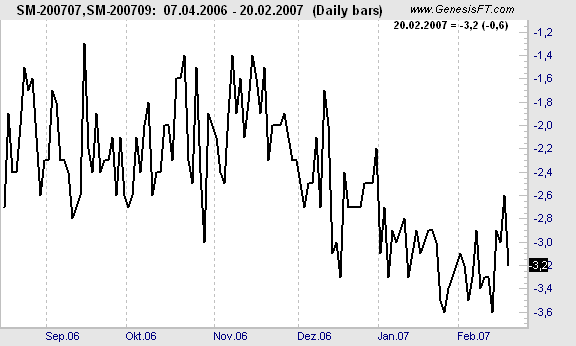
Today we consider an intra-market soybean meal spread: long July 07 Soybean meal and short September 07 Soybean meal (SMN7 – SMU7). This spread trade is mainly based on the optimized seasonal entry (02/26) and exit (05/11) dates and on its reliability over the last 15 years. Just following the statistical entries and exits, the spread would have made money in all of the last 15 years, with a maximum draw down of only $270 in 2004.
Traders may want to enter the spread at a value of –3.5 limit. Margin for the spread is $169 (reduced margin). Suggested risk is $300. Initial projected objective is $300, then a move to 5.0 or higher. Basis is seasonal (app. 2/26 – 5/11).
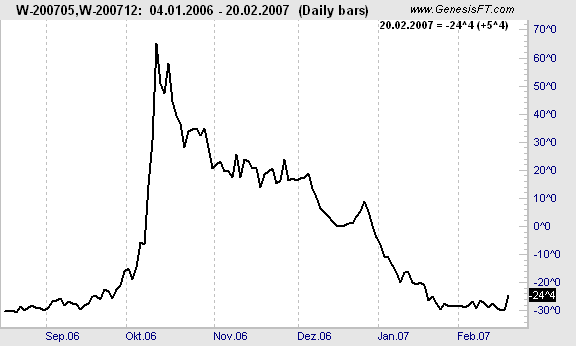
On February 11 we told subscribers of our professional daily spreads & position trading newsletter, Traders Notebook, "Consider entering an intra-market wheat spread WK7 – WZ7 at –28 limit. Margin for the spread is $945 (reduced margin). Suggested risk is $500. Initial projected objective is $500, then a move 0 or even higher. Basis is correlation. Comment: The spread found its bottom last year around –30 and it looks like it doesn’t want to move lower. It’s also a carrying charge spread and therefore limited to the down side. Will it move up? I don’t know, but we will see. Risk seems to be low, possible profits about 2 – 3 times the risk."
Here's how we suggested managing this trade:
02/12 Please let me know when you are in the trade.
02/13 Some traders are already in the trade.
02/16 In?Open equity: $150 per contract.
For more information about our daily newsletter, visit our website:
http://tradingeducators.com/studentsonly.htm or visit our Spread Website to find out more about Traders Notebook
Questions or Comments? Please email us: support@spread-trading.com

Something important from Joe Ross about bull and bear spreads:
Bull and bear spreads perform opposite economic functions. The former rations demand; the latter distributes supply. In most demand-driven markets for a physical commodity, nearby contracts increase relative to deferred contracts. In the first stage, usually associated with plentiful supply and futures in their normal progression (Contango — prices being progressively higher in the deferred months), cash prices stabilize while commercials continue to buy what they need as they need it, as opposed to forward pricing. This buying on an as-needed basis steadies the nearby futures while further eroding deferred prices. As demand begins to outstrip production, cash prices rise. Knowledgeable commercials not only continue to buy their immediate needs, but also begin to slowly accumulate physical inventories. Their actions affect futures in the same way as does tossing a pebble into a pond, which creates concentric circles - most intense nearby, and progressively less with distance. In the latter stages, if demand exceeds supply, the price for nearby delivery can exceed that for deferred delivery as the market wants the physical commodity now, not later. If that keeps up, futures can go into backwardation (inverted market) - a price structure in which progressively deferred contracts are priced at progressively greater discounts. The eventual economic function of continued bull spreading is to restrict supply to the most productive (efficient) demand by making immediate consumption the most expensive.
© 2007 by Trading Educators, Inc
Contact
Us
1509 Jackson Drive
Cedar Park, TX 78613
Phone: 800-476-7796 or 512-249-6930
You
can e-mail us: support@spread-trading.com
Office hours are Monday - Friday 9 A.M. to 5 P.M., U.S.C.T.
Unsubscribe or change subscription
To change your subscription or to unsubscribe, scroll past the end of this
newsletter to click the "unsubscribe" link.
Disclaimer:
The Commodity Futures Trading Commission has asked us to advise you that trading spreads is complex and carries a high degree of risk. While there is opportunity for incredible wealth building, there is also the risk of losing even more than you invested. Of course, that's not unlike most other businesses. But informed traders are the best traders!