
You
have subscribed to Joe Ross' Weekly Spread Scan Newsletter.
If you have problems reading this newsletter, please follow this link:
Spread
Scan Issue: April 11, 2007 - Volume 139
This email was sent to you by Trading Educators.
To ensure delivery to your inbox (rather than to bulk or junk folders)
please add info@spread-trading.com to your address book.To unsubscribe, scroll past the end of this newsletter and click the "unsubscribe" link.
Otherwise, welcome to this week’s issue of the
Joe Ross Spread Trading Newsletter.Each week we present spread trading examples and opportunities in order to help you become a more professional spread trader.
Be sure you receive all your issues of Spread Scan so that you can continue to enjoy learning through the best free educational trading information available, and so that we can keep you informed about additional educational services and products to help you grow as a successful and profitable spread trader.
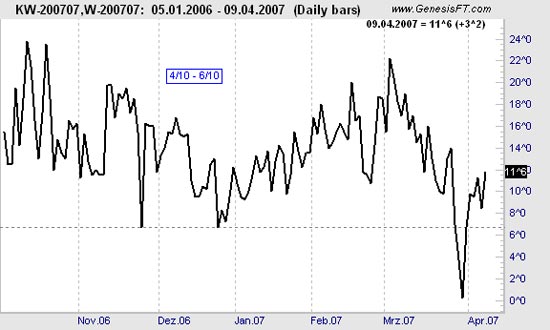
Today we consider an inter-exchange spread: long July 07 Kansas City Wheat and short July 07 Chicago Wheat (KWN7 – WN7). The spread doesn’t look “smooth” on the daily chart so far because the main volume is still in the May contracts. The spread dropped down to break even end of March, and now gives us a 1-2-3 low for a possible entry. It has stayed above 6 ¾ on the weekly chart, so that could be a good number for the initial stop.
Traders may want to enter the spread Market on Close (MOC) in the next few days. Margin for the spread is $816 (reduced margin). Suggested risk is $500. Initial projected objective is $500, then a move to 44 or higher. Basis is seasonal (app. 4/10 – 6/10) and a 1-2-3 low.
On April 02 we told subscribers of our professional daily spreads & position trading newsletter, Traders Notebook, "Consider entering an inter-market spread KWN7 – CN7 at a spread value of 81. Margin for the spread is $2,850 (no reduced margin). Suggested risk is $600. Initial projected objective is $600, then a move to 125 or higher. Basis is seasonal (app. 4/6 – 5/20). Comment: I personally would wait for a nice break out and enter on the next day MOC."
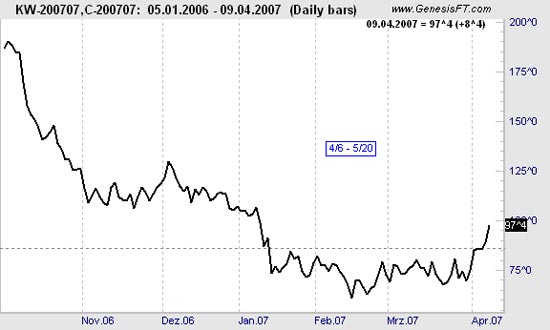
Here's how we suggested managing this trade:
04/02 Suggest entering MOC tomorrow.
04/03 In?
04/09 Spread is close to our first suggested target. Suggest taking some profits if not already done and moving stop to break even.For more information about our daily newsletter, visit our Spread Website to find out more about Traders Notebook
Questions or Comments? Please email us: support@spread-trading.com

Student's Question: "Andy, lately I've been thinking a LOT about my exits. I analyzed previous trades, did some back testing with my computer. And I thought and thought and thought. I'm in a huge conflict when it comes to scaling out or when to take profits. Any comments about it?"
Andy: The problem you are facing at the moment is a tough one. It is so tough because it is definitely one of the most important factors in trading. I went through the whole process more than once, and found out “there is no best way” (as often happens in trading).
Everything from “scaling into a trade” to “scaling out of a trade” will work, but it depends on the trader himself, and on his or her way of trading.
What you can do is to go over your own past results. Find out what would have given the best results for you each time, and then use that information to make your trading plan for future trades.
Also look at different ratios for your lots when scaling out. You might find out it is better to exit all contracts at once, but you feel better when taking some profits at the first target. If this is the case, maybe a 20% first target, 80% final target could be a solution. Or even 10/90, or any other ratio. Try to find out what works best for you! But don’t try to find the perfect way – it doesn't exist.
This is what the best traders do:
They find a way of trading the markets that enables them to get in and get out with the greatest probability of profits - time after time, after time. They find a method of trading that most other traders have never attempted. The idea is to find not only high probability trades that give traders the best use of their margin accounts, but also to find a way to avoid being a victim of stop running, that nasty enemy of most traders.
Since the 1990's I studied the markets from the point of view of how traders could make money steadily, getting the most efficient use of their money, while at the same time taking advantage of high percentage trades. Some of the best traders I know are doing this, but you are not going to see them interviewed on any TV money show. They are knowledgeable, successful, and respected among trading professionals who are "in the know."
The way of trading I'm talking about has been successful for me throughout my entire trading career. What I'm talking about is learning to trade spreads, and I believe almost anyone, with the right training, has the potential to quickly and easily make money trading them. Please follow this link and let me introduce you to a fascinating and lucrative world most traders will never realize exists....

© 2007 by Trading Educators, Inc
Contact
Us
1509 Jackson Drive
Cedar Park, TX 78613
Phone: 800-476-7796 or 512-249-6930
You
can e-mail us: support@spread-trading.com
Office hours are Monday - Friday 9 A.M. to 5 P.M., U.S.C.T.
Unsubscribe or change subscription
To change your subscription or to unsubscribe, scroll past the end of this
newsletter to click the "unsubscribe" link.
Disclaimer:
The Commodity Futures Trading Commission has asked us to advise you that trading spreads is complex and carries a high degree of risk. While there is opportunity for incredible wealth building, there is also the risk of losing even more than you invested. Of course, that's not unlike most other businesses. But informed traders are the best traders!