
You
have subscribed to Joe Ross' Weekly Spread Scan Newsletter.
If you have problems reading this newsletter, please follow this link:
Spread
Scan Issue: May 23, 2007 - Volume 145
This email was sent to you by Trading Educators.
To ensure delivery to your inbox (rather than to bulk or junk folders)
please add info@spread-trading.com to your address book.To unsubscribe, scroll past the end of this newsletter and click the "unsubscribe" link.
Otherwise, welcome to this week’s issue of the
Joe Ross Spread Trading Newsletter.Each week we present spread trading examples and opportunities in order to help you become a more professional spread trader.
Be sure you receive all your issues of Spread Scan so that you can continue to enjoy learning through the best free educational trading information available, and so that we can keep you informed about additional educational services and products to help you grow as a successful and profitable spread trader.
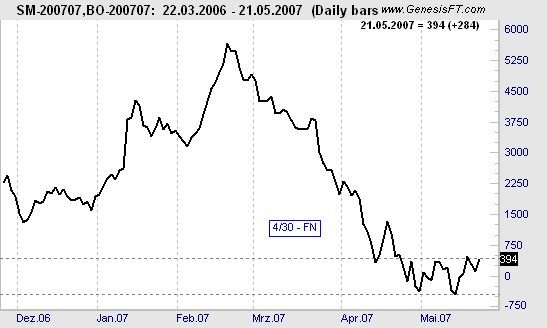
Today we consider an inter-market equity spread: long July 07 Soybean Meal and short July 07 Soybean Oil (100*SMN7 – 600*BON7). After being in a down trend for more then two months, the spread has been in a sideways market since the end of April. Is this the end of the long term down trend and the begin of its seasonal up move?
Traders may want to enter the spread at a value of 490. Margin for the spread is $1,688 (no reduced margin). Suggested risk is $700. Initial projected objective is $700, then a move to 4,500 or higher. Basis is seasonal (app. 4/30 – 6/28) and a break out of a trading range. Because of the different values of each unit move of Soybean Meal and Soybean Oil, we have to multiply the buy side by 100 and the sell side by 600 to get the right equity chart. The spread is 1:1.
On May 14 we told subscribers of our professional daily spreads & position trading newsletter, Traders Notebook,"Consider selling June Gold at 667.4 stop market (all sessions). Initial margin is $2,700. Suggested stop at 677.7 (app. $1,100). Initial projected objective is 660, then a move down to 640 or lower. Basis is seasonal (app. 5/10 – 6/10) and a Traders Trick Entry in front of a Hook."
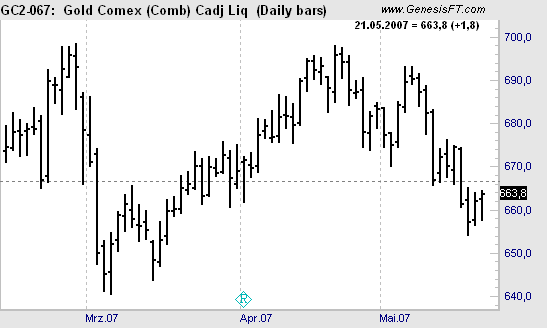
Here's how we suggested managing this trade:
05/15 Short at 667.4. Suggested stop at 677.7.
05/16 Trade hit first suggested target. Suggest moving stop to break even (or 673 if you prefer to stay in the position for a long term trade).
05/18 Suggest moving stop to 666.7.For more information about our daily newsletter, visit our Spread Website to find out more about Traders Notebook
Questions or Comments? Please email us: support@spread-trading.com

Spreading Against a Related Contract
In this instance, you spread by taking an opposite position in a related contract. You might spread corn against wheat. You might spread heating oil against unleaded gasoline. Quite often, operators who trade large size contracts and are market makers hedge the S&P 500 by taking an opposite position in the Nasdaq or the Dow.
Soybean traders often hedge by spreading off against the meal, the oil, or both. When they do both, they are in effect trading the crush.
Crude oil traders can hedge by using the crack spread.
Spreading a related contract spread carries the same precautions as does spreading against a back month. You must not take the spread if it is going against you. The best way to determine this is to use a line chart to depict the spread.
Spreading against a related contract buys time. That is its value. There are all sorts of philosophical arguments regarding the concept of hedging by spreading.
Some say that all you are doing is locking in your loss. They say it would be better to take a loss, get out, and then get back in when the market is going your way. Such an argument is well taken if you are the type of trader who can take a loss and then turn right around and get back in. If you are this type of person, you do not need to hedge your losses by spreading them off. On the other hand, if losses are devastating to you, if you are the type of person who cannot muster up the courage to go back in right after taking a loss, then you can benefit from the hedge spread.
There's more to it than that. You can protect a winning position by spreading. If you are making a decent profit on a position you've taken, but do not want to take the heat of a correction in the market, you can spread yourself until such time as you are convinced that the market has resumed its trend.
The flip side to this argument is that you should take profits and then get back in when you are convinced that the market has resumed its trend.
What I'm trying to do for you here is to present you with an alternative you may not have realized you had.
The arguments could go back and forth all day without any agreement as to which way is the better way. The answer is to protect yourself in a way that is the most comfortable to you; in a way that best fits your own temperament and trading style.
It's good to know there are alternatives to simply being stopped out in a market. You don't have to be put out of business when you don't want to.
The market makers use the spread technique to hedge themselves. You, too, should consider doing it.
Newly revised book for traders: Trading is a BusinessSTOP GAMBLING!
Change your trading life - let Joe Ross show you
the professional way to trading success!You will not only learn HOW TO TRADE, I will show you HOW TO MAKE PROFITS FROM TRADING.
"I purchased four of your books and I think that, there is no other material on the market today that can be compared with the information found in your books. For an aspiring trader those books are a must. For me I think that it shortens the learning curve by few years and by untold amounts of dollars."
-- Florin Popa
©
2007 by Trading Educators, Inc
Contact
Us
1509 Jackson Drive
Cedar Park, TX 78613
Phone: 800-476-7796 or 512-249-6930
You
can e-mail us: support@spread-trading.com
Office hours are Monday - Friday 9 A.M. to 5 P.M., U.S.C.T.
Unsubscribe or change subscription
To change your subscription or to unsubscribe, scroll past the end of this
newsletter to click the "unsubscribe" link.
Disclaimer:
The Commodity Futures Trading Commission has asked us to advise you that trading spreads is complex and carries a high degree of risk. While there is opportunity for incredible wealth building, there is also the risk of losing even more than you invested. Of course, that's not unlike most other businesses. But informed traders are the best traders!