
You
have subscribed to Joe Ross' Weekly Spread Scan Newsletter.
If you have problems reading this newsletter, please follow this link:
Spread
Scan Issue: July 18, 2007 - Volume 153
This email was sent to you by Trading Educators.
To ensure delivery to your inbox (rather than to bulk or junk folders)
please add info@spread-trading.com to your address book.To unsubscribe, scroll past the end of this newsletter and click the "unsubscribe" link.
Otherwise, welcome to this week’s issue of the
Joe Ross Spread Trading Newsletter.Each week we present spread trading examples and opportunities in order to help you become a more professional spread trader.
Be sure you receive all your issues of Spread Scan so that you can continue to enjoy learning through the best free educational trading information available, and so that we can keep you informed about additional educational services and products to help you grow as a successful and profitable spread trader.
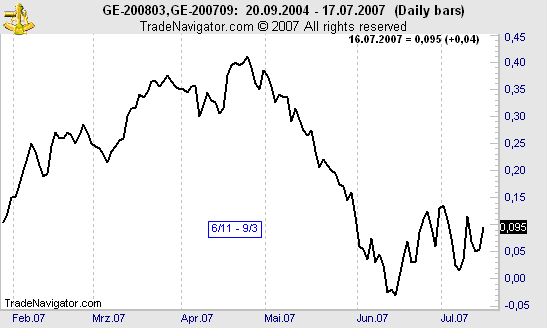
Today we consider a calendar spread: long March 08 Eurodollars and short September 07 Eurodollars (EDH8 – EDU7). After the strong down move in May 2007, the spread seems to be in a sideways range at the moment. Seasonality indicates the spread could move up in the next few weeks (app. 6/11 – 9/3). The July 07 low at 0.015 could be a good place for the initial stop.
Traders may want to enter the spread at a value of 0.12 or higher. Please ask your broker for the margin. Suggested risk is $300. Initial projected objective is $300, then a move higher.
On July 10 we told subscribers of our professional daily spreads & position trading newsletter Traders Notebook, "Consider entering an inter-market spread 50*SIU7 – 100*GCQ7 MOC tomorrow 07/11. Margin for the spread is $6,750 (no reduced margin). Suggested risk is $1,000. Initial projected objective is $1,000, then a move higher. Basis is seasonal (app. 7/20 – 7/30) and a RH. Comment: Be careful when trading inter-market metal spreads. They can move really fast (look what happened end of June)!"
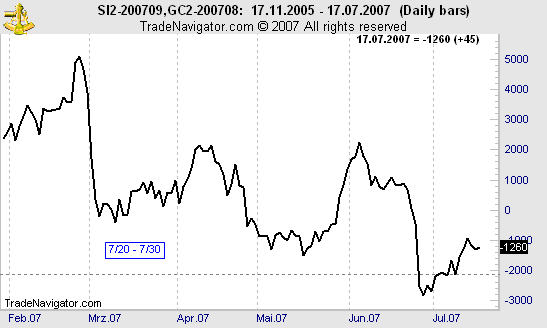
Here's how we suggested managing this trade:
07/11 In?
For more information about our daily newsletter, visit our Spread Website to find out more about Traders Notebook
Questions or Comments? Please email us: support@spread-trading.com

Student's Question: "Andy, I have heard spread trading is less risky than outright futures trading. Is this true?"
Andy: Yes and no — it depends on what kinds of spreads we are talking about. Maybe we should put them into different categories:
High-risk, chaotic spreads: Spreads with each side in a different, unrelated market.
For example, Live Cattle – Emini S&P. These spreads don’t make much sense.High-risk spreads: Inter-market spreads like Feeder Cattle – Live Cattle; Euro – Japanese Yen; Wheat – Soybeans, and so on. Even if the two sides of the spread are related to each other, both sides can behave independently (i.e. Feeder Cattle can move up and Live Cattle down). These spreads can move even faster than a single outright futures position from time to time, especially when it comes to a limit up or down situation in one of the markets involved in the spread.
Mid-risk spreads: Intra-market or calendar spreads in two different crop years like December 07 Wheat – May 07 Wheat. Even if you trade the same market on both sides of the spread, these spreads can move fast because the contracts are in two different crop years. But they are much less sensitive in a limit situation than inter-market spreads.
Low-risk spreads: Intra-market spreads in the same crop year, like September 07 Corn – December 07 Corn. These spreads carry the least risk even in extreme situations.
Whenever you want to enter a spread, think about the relationship of each contract involved. But also have a look at the spread chart, to see how fast the spread has moved in the past. This should give you a good idea of what to expect in the future. Be extremely careful whenever it comes to a limit up or down situation.
©
2007 by Trading Educators, Inc
Contact
Us
1509 Jackson Drive
Cedar Park, TX 78613
Phone: 800-476-7796 or 512-249-6930
You
can e-mail us: support@spread-trading.com
Office hours are Monday - Friday 9 A.M. to 5 P.M., U.S.C.T.
Unsubscribe or change subscription
To change your subscription or to unsubscribe, scroll past the end of this
newsletter to click the "unsubscribe" link.
Disclaimer:
The Commodity Futures Trading Commission has asked us to advise you that trading spreads is complex and carries a high degree of risk. While there is opportunity for incredible wealth building, there is also the risk of losing even more than you invested. Of course, that's not unlike most other businesses. But informed traders are the best traders!